Your Breath Acetone Is Telling a Story — What Do Its Daily Fluctuations Reveal?
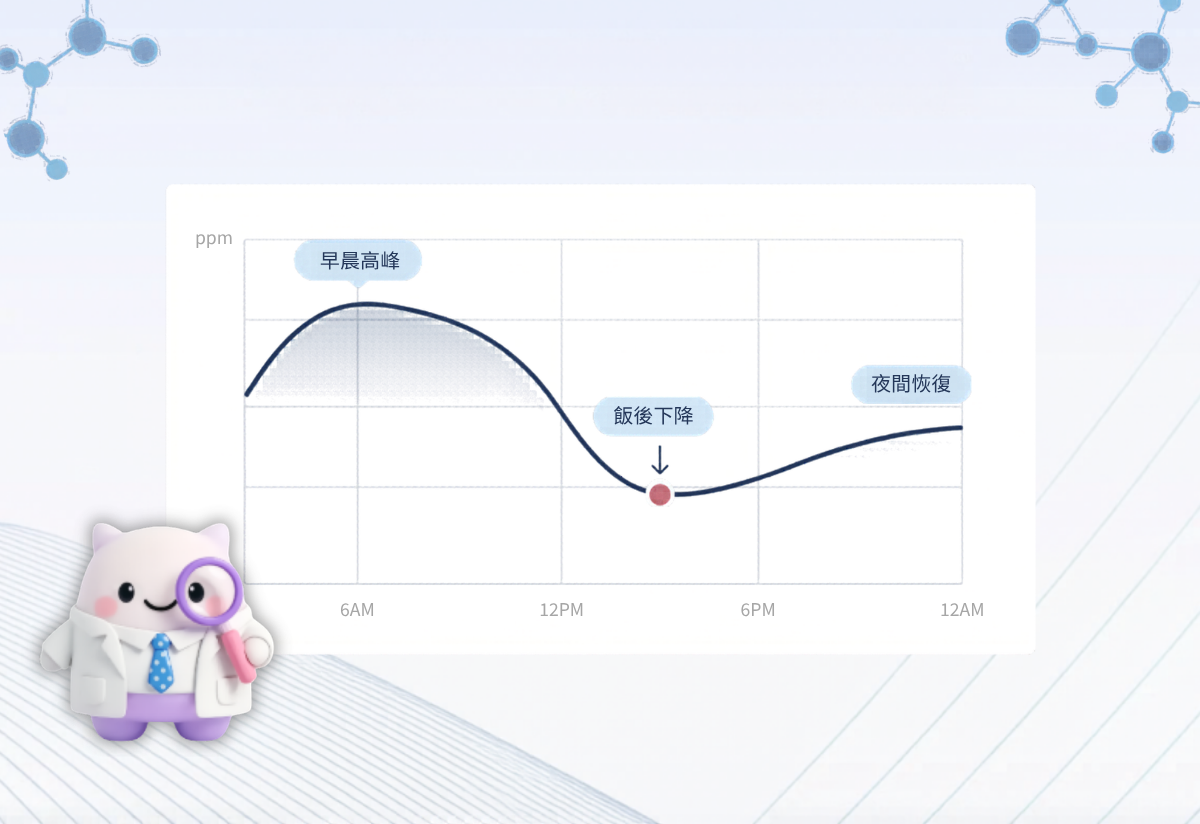
Have you ever noticed that your breath acetone reading first thing in the morning is very different from the number you get after lunch? It's not because the device is broken — it's because your body is "switching fuel modes."
Morning: The Peak of the Day
After a full night of sleep (typically 7–8 hours without food), your body has already burned through most of the easily-accessible carbohydrates and has begun relying more heavily on fat. So the morning fasted state is usually when breath acetone is at its highest during the day.
Studies show that during a low-carb diet, participants' morning fasted breath acetone reached a stable 8.2 ppm — indicating that the body had been burning fat efficiently throughout the night.
After Meals: Carbohydrates Cause a Sharp Drop
Once you eat a meal containing carbohydrates, blood sugar rises, insulin secretion increases, and the body "switches back" to burning carbohydrates, slowing down fat breakdown.
One experiment observed that after participants in a stable ketotic state ate a carbohydrate-containing meal, their breath acetone dropped significantly from 8.2 ppm to 5.7 ppm — a decrease of nearly 30%. Furthermore, it took a full 5 days to return to the original ketotic level.
What's even more noteworthy: the higher a person's fasting insulin, the more strongly fat breakdown is suppressed, and the slower breath acetone recovers. This also explains why some people feel that "one cheat meal" completely derails their progress.
Nighttime: Sleep Quality Also Affects Breath Acetone
A research team from Taipei Medical University found that overnight changes in breath acetone are closely linked to sleep quality. People with normal sleep quality showed a slight overnight increase in breath acetone (from 2.30 to 2.34 ppm), reflecting normal overnight fat metabolism.
However, people with moderate to severe obstructive sleep apnea actually showed a decrease in breath acetone overnight (from 2.36 to 2.13 ppm). This indicates that sleep disorders disrupt nighttime fat metabolism — poor sleep doesn't just make you feel groggy the next day; it also reduces your fat-burning efficiency.
Make the Most of Breath Acetone's Daily Rhythm
Once you understand these patterns, you can use your breath acetone meter more intelligently:
Measure in the morning while fasted to establish your daily baseline. Measure again 2–3 hours after meals to observe how your diet affects your metabolism. Track trends over multiple days rather than fixating on a single number. Treat breath acetone as your "metabolic diary" — it faithfully records how your diet and lifestyle habits are affecting your body.
References: Müller et al. (2024) Effects of a Carbohydrate Meal on Lipolysis; Chen et al. (2025) Associations between breath acetone overnight dynamics and obstructive sleep apnea; Bovey et al. (2018) Breath acetone as a marker of energy balance